
Macroeconomic data announcement, Omicron situation and global trends will be the major driving factors for the equity market in the first week of the new year 2022, according to analysts. In what turned out to be a historic year, the Indian stock indices went past multiple milestones and the 30-share Sensex made an annual gain of 10,502.49 points or 21.99 per cent in 2021. Religare Broking Vice-President (Research) Ajit Mishra said, "This week marks the beginning of a new month and participants will be closely eyeing some crucial high-frequency data like monthly auto sales, India manufacturing PMI and India services PMI. "Besides, updates on the COVID-19 situation and performance of global markets will also be critical."

Strong Q3 brings Infosys comfort amid macro risks.

BofA Securities has revised its year-end Nifty target from its earlier projection of 16,000 to 14,500 now - down over 6 per cent from the current levels. Fast tightening monetary conditions, slowing growth/fears of US recession and the likely Nifty EPS (earnings per share) cuts, BofA Securities said, are the key headwinds for the markets in the near-term. However, clarity on macro and monetary policy outlook in the US/India, it said, is the silver lining that could see markets bottom out by August/September 2022.

While analysts predicted the Sensex to cross 30,000 in 2016, the index currently stands 12% lower at 26,400.

Benchmark equity indices Sensex and Nifty reversed their early gains to close lower on Wednesday due to selling in oil & gas, banking and IT stocks amid weak trends in European markets. The 30-share BSE Sensex declined by 372.46 points or 0.69 per cent to close at 53,514.15, extending its falling streak to a third day. The index opened higher and touched the day's high of 54,211.22 amid gains in Asian markets.

Investors are yet to warm up to the concept of sustainable investing with sustainable or ESG (environmental, social, and governance) funds in India witnessing outflows of Rs 315 crore in 2021-22. This comes following a staggering inflow of Rs 4,884 crore in FY 2020-21. Prior to that, sustainable funds saw an infusion of over Rs 2,000 crore, according to data compiled by Morningstar India.

Equity benchmark BSE Sensex closed at an all-time high of 62,272.68 on Thursday, tracking a firm trend in global markets after the US Fed minutes indicated a slower pace of rate increase that bolstered investors' sentiment. Extending its rally to the third straight day, the 30-share BSE benchmark rallied 762.10 points or 1.24 per cent to settle at 62,272.68, its record closing peak. During the day, it jumped 901.75 points or 1.46 per cent to its lifetime high of 62,412.33.he broader NSE Nifty gained 216.85 points or 1.19 per cent to end at 18,484.10.

The rupee slipped by 4 paise to close at 77.59 (provisional) against the US dollar on Tuesday, weighed down by a negative trend in domestic equities and unabated foreign fund outflows. At the interbank foreign exchange market, the rupee opened lower at 77.56 against the greenback, and finally settled at 77.59, down 4 paise over its previous close. During the trading session, the rupee touched an intra-day low of 77.67 and a high of 77.51.
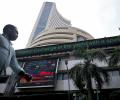
RBI policy, macro data, company earnings to decide market course this week: Experts

The BSE Sensex maintained its winning run for the fourth session on the trot on Wednesday to reclaim the 60,000-level after a gap of over four months as investors remained upbeat amid softening crude oil prices and persistent foreign fund inflows. A strengthening rupee and positive Asian markets further bolstered sentiment, traders said. The 30-share BSE benchmark jumped 417.92 points or 0.70 per cent to settle at 60,260.13 -- closing above the psychologically key 60,000-mark for the first time since April 5 this year.

The correction seen in the stock markets thus far is insufficient and there are significant downside risks, given the way macroeconomic data is shaping up, a Nomura equity strategist said on Thursday. "The markets are trying to look through the current stress we see in the macros. There are potential risks to the market. "Our estimates assume no major impact on growth and earnings. "The market should have been at least 5 per cent lower than it is now.

With the Nifty50 just about 3 per cent away from its all-time closing high of 18,812 points, analysts at BofA Securities suggest investors book profit. Their reasons for the advice include risks like the possibility of a cut in corporate earnings growth forecasts, high valuation (one-year forward P/E of 19.5x), interest rates staying elevated for longer-than-expected and credit tightening. Going ahead, they expect the Nifty50 index to drop to 16,000 levels - down nearly 12 per cent from the current level of 18,255 points, which they believe would be a good time to buy.

'Advertising this season will help IPL surpass $550 million in ad revenues, across digital and pay TV.' 'It should still represent a steep loss against annualised 2023-2027 IPL rights fees of $1.2 billion.'

'Large-caps are better placed to withstand the impact of higher input cost inflation, rising rates and withdrawal of excess global liquidity.'

ITC was the top gainer in the Sensex pack, rising around 3 per cent, followed by HDFC Bank, PowerGrid, ICICI Bank, IndusInd Bank and NTPC. Nifty surged 176.80 points to a new lifetime closing high of 18,338.55.

Benchmark indices Sensex and Nifty retreated from over one-week highs to close lower on Wednesday due to profit booking in banking, IT and metal stocks amid weak global trends. After a two-day rally, the 30-share BSE Sensex dropped by 90.99 points or 0.16 per cent to settle at 57,806.49 in volatile trade. As many as 19 of its constituents declined while 11 advanced. The broader Nifty slipped by 19.65 points or 0.11 per cent to close at 17,213.60 with 31 of its stocks ending in the red.

The rupee tumbled 19 paise to close at a fresh lifetime low of 77.93 against the US dollar on Friday as rising crude oil prices and unabated foreign capital outflows soured sentiment. A sell-off in equity markets and stronger greenback overseas also weighed on the domestic unit, forex traders said. At the interbank foreign exchange market, the local currency opened at 77.81 and witnessed an intra-day high of 77.79 and a low of 77.93 against the US dollar.

Investors continue to back-up equity mutual funds in June as such schemes attracted a net inflow of Rs 15,498 crore on strong flows from systematic investment plans despite volatility in the stock market and relentless selling by Foreign Portfolio Investors (FPIs). This also marked the 16th straight month of positive inflow in equity schemes. Inflows into equity mutual funds in June was lower compared to the net inflow of Rs 18,529 crore seen in May, data from the Association of Mutual Funds in India (AMFI) showed on Friday.
As markets complete the first half of the calendar year 2022 (CY22) with a fall of around 9 per cent, the interest-rate hike trajectory by global central banks, paired with the conundrum of inflation and growth, will move the needle for the market, observe experts. Here's a quick rundown on what they'll react to over the next six months.

Dalal Street investors became richer by more than Rs 16.36 lakh crore this year as the equity market scaled new highs despite persistent geopolitical uncertainties and inflation worries. Analysts attributed better macroeconomic fundamentals, the confidence of retail investors and foreign investors investing again in the domestic equities towards the latter half of 2022 as the key factors that led to the outperformance of the Indian market in comparison to many other stock markets worldwide. During the initial part of the year, markets were jolted by the Russia-Ukraine war.

Retail inflation fell to a 15-month low of 5.66 per cent in March, mainly due to a decline in food prices, government data showed on Wednesday. The inflation figure in March is within the RBI's comfort zone as it is below 6 per cent. The retail inflation based on Consumer Price Index (CPI) was 6.44 per cent in February 2023 and 6.95 per cent in the year-ago period.

Overseas investors have pulled out a net Rs 1,14,855.97 crore from the Indian markets in the current year so far, amid heightened geopolitical tensions and inflation concerns. Foreign portfolio investors have sold domestic equities worth Rs 48,261.65 crore so far this month, taking the year-to-date tally this year to a massive Rs 114,855.97 crore, according to depositories data. The exodus of foreign investors was largely owing to inflationary pressures and deepening global macroeconomic conditions following the Russia-Ukraine war, experts said.

Over the next three - six months, UBS believes earnings will be the main driver for EM equities outperformance.

Analysts agree China, Greece and US Fed developments need careful monitoring but India should gain, over time, from relative rise of the dollar and fall in commodity prices.

'One of the biggest employment generators, the MSMEs, have not got much from the government.'

The derivatives expiry on Thursday is also expected to add to the volatility.

PowerGrid was the top gainer in the Sensex pack, spurting 2.76 per cent, followed by NTPC, M&M, L&T, Hindustan Unilever, HDFC, and Infosys.

Overseas investors had put in a net sum of Rs 45,981 crore in March and Rs 11,182 crore in February in the capital markets

Despite unprecedented levels of uncertainty in Samvat 2077, investors have little to complain about on the returns front. The BSE Sensex delivered returns of 38 per cent in this period, while the Nifty registered a return of over 40 per cent. As is the case in bull markets, companies in the small- and mid-capitalisation basket outperformed the benchmarks, with returns almost twice those of frontliners.

Being one of the early commentators to flag economic slowdown and caution investors on corporate earnings, Gautam Chhaochharia, head of India research, UBS Securities, in an interview with Hamsini Karthik says the markets remain in an expensive zone despite the recent correction.

The Indian indices also offer one of the lowest dividend yields.

Sustaining positive momentum for the 14th straight month, equity mutual funds attracted a net sum of Rs 15,890 crore in April amid heightened volatility in stock market and consistent selling by foreign portfolio investors. This was much lower compared to a record net inflow of Rs 28,463 crore seen in the preceding month, data from the Association of Mutual Funds in India (AMFI) showed on Tuesday. The lower quantum of net inflow from the previous month could be attributed to investors going slightly cautious given the ongoing challenges to the investment environment, Himanshu Srivastava, associate director - manager research, Morningstar India, said.

While discretionary spend by global enterprises is likely to negatively impact all Indian IT firms, more revenues from products and less exposure to financial services segment are likely to lessen the impact for HCL Technologies and Tech Mahindra.

To threaten China and Pakistan, and then to sharply cut back on military funding, bespeaks a remarkable trust in Beijing and Islamabad that is not borne out by anything they say or do, notes Ajai Shukla.

Kunal Shah is one of five of India-origin to have made the cut in Goldman Sachs in the 2014 class of partners.

Despite headwinds, it remains "structurally bullish" on India and expects the Sensex to scale up to the 70,000-mark by December 2022; 80,000 level in a bull-case scenario and hover around the 50,000-mark as a bear-case, the brokerage house said in a report.

The government is expected to defer the mega initial public offering (IPO) of LIC to the next financial year as the ongoing Russia-Ukraine war has dampened fund managers' interest in the public issue, market experts said on Sunday. The government was looking to sell 5 per cent stake in Life Insurance Corporation (LIC) this month, which could have fetched over Rs 60,000 crore to the exchequer. The IPO would have helped meet the curtailed divestment target of Rs 78,000 crore this fiscal.

At BSE, 1,799 scrips declined and 714 advanced, while 184 remained unchanged.

'Avoid going overweight on gold. But maintain a 10 per cent allocation via sovereign gold bonds,' Bajaj Capital MD Sanjiv Bajaj tells Sarbajeet K Sen.

'It won't help being complacent about the momentum and valuations of equities that currently exist.'
 © 2026 Rediff.com - Advertise with us - Disclaimer - Privacy Policy - Sitemap - Feedback - About us - Terms of use - Grievances